 Boilersinfo Boiler and Mechanical Power Digital Library
Introduction to Industrial Pumping Systems
Why Pumps Are Essential in Modern Industry
If you think about it, modern civilization literally runs on the movement of fluids. Water must be pumped to cities, chemicals must flow through industrial plants, and fuels must travel through pipelines before they reach engines or turbines. Behind almost all of these processes lies a mechanical device that quietly performs the essential job of moving liquids from one place to another—the pump. Among the wide range of pump technologies available today, centrifugal pumps and rotary pumps are the most widely used in engineering and industrial operations.
Pumps serve as the heart of countless systems. Without them, cooling systems in power plants would fail, irrigation systems would stop functioning, and oil refineries would struggle to transport crude and refined products. Engineers rely on pumps to maintain continuous flow, maintain pressure, and ensure safe transfer of liquids under different process conditions. In simple terms, a pump converts mechanical energy into hydraulic energy to move fluids through pipelines and systems.
From municipal water supply to petrochemical processing, pumps play a crucial role in maintaining operational efficiency. Their design, reliability, and energy efficiency significantly influence production costs and plant safety. That’s why understanding the fundamentals of centrifugal and rotary pumps is essential for engineers, operators, technicians, and maintenance personnel working in any fluid-handling industry.

Global Demand and Market Growth of Pumps
The importance of pumps is reflected in the massive global demand for them. In fact, centrifugal pumps account for around 80% of the total number of pumps used worldwide, making them the most widely deployed pump type in industrial applications. Rotary pumps, which belong to the positive displacement pump family, represent roughly 10% of global pump usage, often chosen for specialized applications requiring precise flow control or high-viscosity fluid handling.
The pump industry continues to grow as industrialization, infrastructure development, and urbanization expand across the globe. Recent reports indicate strong demand from sectors such as agriculture, water treatment, oil and gas, and power generation, where reliable pumping systems are essential for continuous operation. Agriculture alone accounted for over 25% of centrifugal pump applications in 2025, driven largely by irrigation and water management projects.
Technological advancements are also transforming pump systems. Modern pumps now integrate variable frequency drives (VFDs), digital monitoring, and smart control systems that optimize energy efficiency and reduce operational downtime. Some advanced installations have reported energy savings of up to 25–30% using these technologies.
All of this makes one thing clear: pumps are not just mechanical devices—they are fundamental components of global infrastructure and industry.
Fundamentals of Pumps
Basic Concept of a Pump
At its most fundamental level, a pump is a mechanical device designed to move fluids from one location to another by adding energy to the fluid. This added energy increases the fluid’s pressure or velocity, allowing it to overcome resistance in pipelines or systems. Pumps operate by converting mechanical energy from a motor or engine into hydraulic energy within the fluid.
Imagine trying to move water from a low reservoir to a higher tank. Without assistance, gravity would keep the water at the lower level. A pump solves this problem by generating enough force to push the liquid upward or across long distances. In engineering terms, this energy conversion creates flow and head, two essential parameters in pump operation.
Fluid movement inside pumps can occur in several ways. Some pumps use rotating impellers to accelerate the liquid, while others trap and push fixed volumes of fluid using mechanical elements such as gears or screws. These differences in operating principles lead to different categories of pumps, each suited for specific industrial conditions.
Understanding these fundamental principles helps engineers choose the correct pump type for specific applications. Selecting the wrong pump can lead to poor efficiency, mechanical failure, or excessive energy consumption.
Classification of Pumps
Pumps are generally divided into two primary categories based on how they move fluid: dynamic pumps and positive displacement pumps.
Dynamic Pumps
Dynamic pumps operate by continuously imparting energy to the fluid using rotating elements. The most common example is the centrifugal pump, where a spinning impeller accelerates the liquid outward. The fluid gains kinetic energy and is then converted into pressure energy as it flows through the pump casing.
These pumps are widely used in applications requiring high flow rates, such as water supply systems, cooling circuits, and irrigation networks. Because of their simple design and smooth operation, dynamic pumps are often the first choice for transferring large volumes of relatively low-viscosity fluids like water or light oils.
Positive Displacement Pumps
Positive displacement pumps move fluid by trapping a fixed amount of liquid and physically pushing it through the pump. Rotary pumps fall under this category and use mechanisms such as gears, lobes, or screws to displace fluid from the suction side to the discharge side.
Unlike centrifugal pumps, positive displacement pumps provide nearly constant flow regardless of pressure variations. This makes them ideal for applications involving viscous liquids, precise dosing, or high-pressure systems. Because they physically move a defined volume with each rotation, they are commonly used in chemical processing, lubrication systems, and food processing industries.
Fundamentals of Centrifugal Pumps
Working Principle of Centrifugal Pumps
A centrifugal pump works on a relatively simple yet powerful concept: centrifugal force. Liquid enters the pump near the center of a rotating impeller and is accelerated outward due to the rotation of the impeller blades. As the liquid moves outward, its velocity increases, and this kinetic energy is later converted into pressure energy in the pump casing. (Pumps and Systems Magazine)
Picture a spinning umbrella in the rain. Water droplets move outward due to the rotation, flying away from the center. A centrifugal pump uses the same principle, but inside a controlled casing designed to guide the fluid into pipelines.
The process occurs in three main steps:
- Liquid enters the pump through the suction inlet.
- The impeller rotates, increasing the velocity of the fluid.
- The pump casing converts this velocity into pressure energy, pushing the fluid into the discharge pipe.
Because centrifugal pumps operate continuously rather than in discrete strokes, they provide smooth and steady flow. This makes them particularly useful for large-scale water transport and industrial fluid circulation systems.
Key Components of Centrifugal Pumps
Centrifugal pumps may appear simple from the outside, but internally they consist of several critical components that work together to ensure efficient operation.
The impeller is the heart of the pump. This rotating element contains curved blades designed to accelerate the fluid outward. The shape, diameter, and speed of the impeller determine the pump’s performance characteristics, including flow rate and pressure head.
Another essential component is the pump casing, which surrounds the impeller. The casing collects the fluid leaving the impeller and converts velocity into pressure before directing the fluid toward the discharge outlet.
The shaft and bearings support the rotating impeller and transfer power from the motor. Meanwhile, mechanical seals or packing prevent leakage along the rotating shaft.
Together, these components create a robust system capable of moving enormous volumes of liquid with relatively simple mechanical design.
Advantages and Limitations
Centrifugal pumps offer several advantages that explain their widespread use across industries. They are relatively inexpensive, simple to maintain, and capable of delivering very high flow rates. Their smooth and continuous flow also makes them suitable for systems requiring stable hydraulic conditions.
However, they also have limitations. Their efficiency drops significantly when handling highly viscous fluids or operating under very high pressures. Additionally, centrifugal pumps usually require priming, meaning the pump must be filled with liquid before starting to avoid air pockets that disrupt operation.
Types of Centrifugal Pumps
Radial Flow Pumps
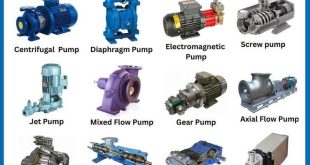
Radial flow pumps are the most common centrifugal pump design. In this configuration, fluid enters the pump axially and exits radially through the impeller blades. These pumps are typically used in applications requiring high pressure but moderate flow rates, such as boiler feed systems and industrial water supply.
Mixed Flow Pumps
Mixed flow pumps combine characteristics of radial and axial flow designs. Fluid moves partly outward and partly along the axis of the impeller. These pumps provide a balance between pressure and flow rate, making them ideal for irrigation, flood control, and large-scale water transfer systems.
Axial Flow Pumps
Axial flow pumps move fluid parallel to the pump shaft, similar to the operation of a propeller. These pumps are capable of handling very large flow rates with relatively low pressure, making them suitable for drainage systems, cooling water circulation, and flood management.
Fundamentals of Rotary Pumps
Working Principle of Rotary Pumps
Rotary pumps operate on a completely different principle compared to centrifugal pumps. Instead of using centrifugal force, they trap a fixed volume of liquid and move it through the pump using rotating components such as gears, lobes, screws, or vanes. (michael-smith-engineers.co.uk)
As the pump rotates, cavities open up on the suction side, allowing fluid to enter. These cavities then close and move toward the discharge side, pushing the fluid out of the pump. This process repeats continuously, producing a steady flow of liquid.
One key advantage of rotary pumps is that the flow rate is almost directly proportional to the pump speed, meaning precise flow control can be achieved by adjusting rotational speed. (Pumps and Systems Magazine)
Types of Rotary Pumps
Rotary pumps come in several different designs depending on the internal mechanism used to move the fluid. The most common types include:
- Gear pumps
- Screw pumps
- Lobe pumps
- Vane pumps
- Progressing cavity pumps
Each type has unique advantages depending on the fluid properties and application requirements.
Advantages and Limitations
Rotary pumps excel in handling high-viscosity liquids, including oils, polymers, and food products. They also provide a consistent flow regardless of pressure changes, making them ideal for metering and dosing applications.
However, these pumps are typically more expensive than centrifugal pumps and may require more precise maintenance due to their tight internal clearances.
Centrifugal vs Rotary Pumps
Key Differences in Operation and Performance
| Feature | Centrifugal Pump | Rotary Pump |
|---|---|---|
| Pump Type | Dynamic | Positive Displacement |
| Flow Behavior | Varies with pressure | Constant flow |
| Viscosity Handling | Low viscosity fluids | High viscosity fluids |
| Self-Priming | Usually not | Often yes |
| Cost | Lower | Higher |
| Typical Speed | High RPM | Low RPM |
Centrifugal pumps can handle extremely high flow rates, sometimes exceeding 27,000 m³/h, while rotary pumps typically handle smaller volumes but with higher pressure capabilities. (michael-smith-engineers.co.uk)
Industrial Applications of Pumps
Applications of Centrifugal Pumps
Centrifugal pumps are used in many industries, including:
- Municipal water supply
- Wastewater treatment
- Agricultural irrigation
- Power plant cooling systems
- Chemical processing
- Fire protection systems
Their ability to handle large volumes of liquid efficiently makes them ideal for large-scale fluid transport systems.
Applications of Rotary Pumps
Rotary pumps are commonly used where precision and viscosity handling are important.
Typical applications include:
- Oil and fuel transfer
- Lubrication systems
- Food and beverage processing
- Pharmaceutical manufacturing
- Chemical dosing systems
Pump Selection Criteria
Selecting the right pump requires careful evaluation of several factors including fluid viscosity, required flow rate, pressure head, temperature, and operating environment. Engineers must also consider efficiency, maintenance requirements, and life-cycle cost.
Choosing the wrong pump type can lead to reduced efficiency, increased wear, and operational failures.
Future Trends in Pump Technology
The pump industry is evolving rapidly with new technologies improving efficiency and reliability. Smart monitoring systems now allow real-time performance tracking, predictive maintenance, and remote diagnostics.
Energy-efficient designs and advanced materials are also helping reduce energy consumption and extend equipment lifespan. As industries move toward automation and sustainability, pump systems will continue to play a critical role in optimizing industrial processes.
Conclusion
Centrifugal and rotary pumps are fundamental technologies that power modern industry. While centrifugal pumps dominate applications involving large fluid volumes and relatively low viscosity, rotary pumps excel in handling viscous liquids and precise flow control.
Understanding the principles behind these pump types helps engineers select the right equipment for specific operational conditions. With advances in digital monitoring, materials science, and energy-efficient designs, the future of pumping technology promises improved performance, reliability, and sustainability across global industries.
FAQs
1. What is the main difference between centrifugal and rotary pumps?
The main difference lies in the pumping mechanism. Centrifugal pumps use rotating impellers to generate velocity and pressure, while rotary pumps move fluid by trapping and displacing a fixed volume with rotating components.
2. Which pump is better for high-viscosity fluids?
Rotary pumps are better suited for high-viscosity fluids because they maintain consistent flow even when fluid thickness increases.
3. Why are centrifugal pumps so widely used?
Centrifugal pumps are simple, reliable, and capable of handling very large flow rates, which makes them ideal for water supply, irrigation, and industrial fluid transport.
4. Do rotary pumps require priming?
Many rotary pumps are self-priming, meaning they can start pumping without needing the pump casing to be filled with liquid beforehand.
5. What industries rely most on pumps?
Industries such as oil and gas, water treatment, agriculture, chemical processing, power generation, and food manufacturing rely heavily on pump systems.